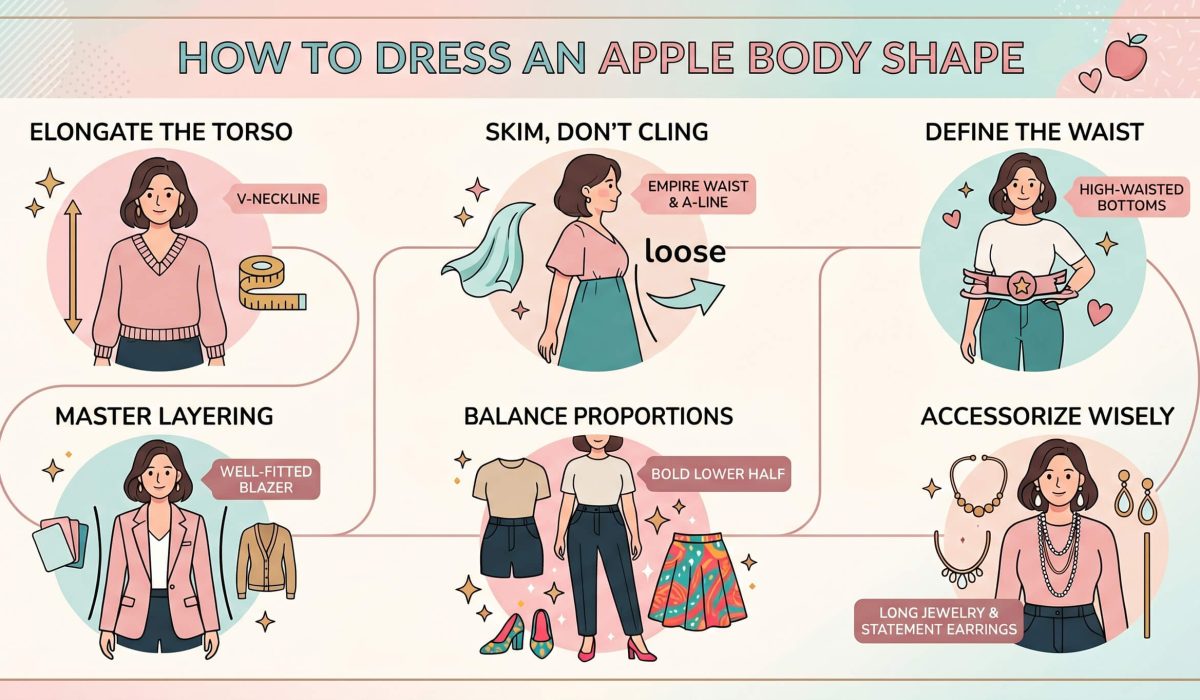
Finding a dress that feels comfortable, looks polished, and suits your personal style can be surprisingly difficult when you’re shopping for an apple-shaped figure. You might find a beautiful dress that fits perfectly around your shoulders but feels tight around your stomach. Another may give you plenty of room but look too loose everywhere else.
The solution isn’t to follow a strict list of dresses you’re “allowed” to wear. Instead, learn how different cuts, fabrics, and details affect the way a dress fits your proportions.
If you’re wondering how to choose dresses for apple shape, this simple step-by-step guide can help you shop with more confidence and fewer fitting-room disappointments.
Step 1: Understand Your Proportions
An apple-shaped figure generally carries more fullness around the bust and middle, while the waist may be less defined. The hips can appear narrower in comparison, and the legs may be relatively slim.
However, body shapes are only general descriptions. You don’t need to match the classic apple shape perfectly to use these tips.
The most useful thing is to notice where your clothes tend to feel tight or loose. Understanding your own proportions will tell you much more than a body-shape label alone.
Step 2: Take Your Measurements
Before buying a new dress, measure your bust, waist, and hips.
These measurements are especially helpful when shopping online because clothing sizes can vary significantly between brands.
Don’t assume that your usual size will always fit. Instead, compare your measurements with the specific retailer’s size chart.
If your bust, waist, and hip measurements fall into different size ranges, pay attention to where the dress is fitted. A loose A-line dress may be easier to choose than a bodycon style with very little room for adjustment.
Step 3: Decide Where You Want the Dress to Fit
Think about the area where you prefer to have definition.
Some apple-shaped women enjoy dresses that fit around the bust and shoulders before flowing away from the stomach. Others prefer a little definition underneath the bust.
This is why styles such as A-line, empire waist, and wrap dresses can be useful starting points.
You don’t necessarily need a dress that creates a dramatic waist. A gentle change in shape can be enough to make the outfit feel more balanced.
Step 4: Choose the Right Waist Placement
Where a dress creates its waistline matters.
A traditional waist seam sits around your natural waist. If you don’t enjoy having a fitted seam across your middle, consider an empire waist, which sits higher underneath the bust.
Wrap dresses are another flexible option because the tie can be adjusted according to your comfort.
You can also choose dresses with no defined waist at all, such as shift dresses, if you prefer a relaxed silhouette.
The best placement is the one that feels natural when you’re standing, sitting, and moving.
Step 5: Pick a Silhouette
Now comes the fun part: choosing the overall shape.
A-Line
An A-line dress is fitted more closely at the top and gradually widens toward the hem. It offers room around the middle and works for casual and dressier occasions.
Wrap
Wrap dresses create diagonal lines across the torso and offer an adjustable fit. They’re a practical choice when you want some waist definition without a rigid waistband.
Empire Waist
An empire-style dress places the fitted section above the natural waist. The skirt then falls more freely, which can make it comfortable around the stomach.
Shift
A shift dress falls away from the body rather than closely following the waist. It’s particularly useful for work, travel, and everyday wear.
Fit-and-Flare
This style fits closer around the upper body before opening into a fuller skirt. It can add structure while still allowing plenty of movement.
Try several silhouettes rather than deciding that one style is automatically best.
Step 6: Pay Attention to the Neckline
The neckline can completely change the appearance of a dress.
V-neck dresses create an open vertical line and can naturally draw attention toward the face and upper body. Scoop and square necklines can provide a similar sense of openness while giving you a different aesthetic.
If you prefer more coverage, a modest V-neck or rounded neckline can work perfectly well.
Don’t choose a neckline simply because someone says it’s flattering. Choose one that feels comfortable and fits your personality.
Step 7: Choose Fabric Carefully
Fabric plays a major role in how a dress looks and feels.
Very thin, clingy fabrics can follow every curve of the body. If you prefer a smoother, less revealing fit, consider fabrics with a little more weight and structure.
Medium-weight knits, cotton blends, crepe, and linen blends can all be useful depending on the style and season.
That doesn’t mean stiff fabric is always better. A material that drapes naturally can be much more flattering and comfortable than something rigid.
When shopping online, always check the fabric composition and read customer reviews for clues about thickness, stretch, and drape.
Step 8: Check the Fit Around Your Bust
Even when you’re mainly concerned about the midsection, don’t ignore the bust.
A dress that is too tight across the chest can pull downward and change the way the entire garment hangs.
Look for enough room to move your arms comfortably. Buttons should lie flat rather than pulling apart, and seams should sit where they’re supposed to.
If the bust fits well but the lower portion is roomy, that’s often easier to work with than trying to squeeze into a smaller size.
Step 9: Consider Sleeve Length
Sleeves can affect the overall balance of an outfit.
Short sleeves keep the look casual, while three-quarter sleeves can offer additional coverage without making the outfit feel heavy.
Long sleeves work well for cooler weather and can make a simple dress feel more polished.
If you like your arms and want to show them, go ahead. There is no requirement to cover them because of your body shape.
Choose sleeves based on comfort, weather, and the look you’re trying to create.
Step 10: Find Your Ideal Dress Length
Dress length should be based on your height, proportions, shoes, and personal preference.
A shorter hem can highlight your legs, while knee-length dresses offer a classic and versatile option. Midi dresses provide more coverage and can look sophisticated with flats, boots, or heels.
Maxi dresses are another great choice if you prefer a long, flowing silhouette.
Try different lengths instead of assuming that one particular hemline is universally better for apple-shaped women.
Step 11: Use Prints and Colors Strategically
Color and pattern are completely personal, but they can help you create different visual effects.
Dark colors can give an outfit a more understated appearance, while bright colors and bold prints naturally attract attention.
If you want to bring attention toward your face, try a dress with an interesting neckline, colorful upper section, or statement pattern.
Vertical details such as long seams or stripes can also add a sense of length.
But don’t feel obligated to wear dark colors. If bright red, floral prints, or colorful patterns make you happy, they’re absolutely worth wearing.
Step 12: Try the Dress While Moving
Never judge a dress only by how it looks while you’re standing still.
Sit down. Walk around. Bend slightly. Raise your arms. Check whether the dress rides up, pulls across your stomach, or feels tight underneath the bust.
The waistband, seams, and neckline should remain comfortable as you move.
If you’re shopping online, look for reviews that mention how the dress fits during normal movement. A return-friendly retailer can also make online shopping less stressful.
Common Mistakes to Avoid
One of the biggest mistakes is choosing a dress that’s much larger than you actually need. Extra fabric doesn’t automatically create a better fit.
Another mistake is buying something extremely tight because you think fitted clothing is more flattering. If you’re uncomfortable, you won’t enjoy wearing the dress.
It’s also easy to focus too much on “hiding” the stomach. Your clothes don’t need to hide anything. If you want more coverage, choose a silhouette that gives you that comfort naturally.
Finally, don’t let a body-shape guide prevent you from trying something new. Fashion should leave room for experimentation.
A Simple Shopping Checklist
Before buying a dress, ask yourself:
- Does it fit comfortably around my bust?
- Is there enough room through the middle?
- Does the waist sit where I want it?
- Can I sit and move comfortably?
- Is the fabric comfortable against my skin?
- Do I like the neckline and sleeve length?
- Does the dress work with shoes I already own?
- Would I genuinely enjoy wearing it?
If most answers are yes, you’ve probably found a strong candidate.
Final Thoughts
Learning how to choose dresses for apple shape is really about understanding fit rather than following fashion restrictions.
Start with your measurements, identify where you want comfort and definition, and then experiment with silhouettes such as A-line, wrap, empire waist, shift, and fit-and-flare dresses.
Pay attention to fabric, neckline, sleeve length, and hemline as well. Most importantly, try the dress while moving—not just while standing in front of a mirror.
Your body doesn’t need to fit a dress perfectly. The dress should fit you.
Once you understand what feels comfortable and looks like “you,” shopping becomes much easier. And instead of searching for a dress that supposedly hides your shape, you can focus on finding one that makes you feel confident wearing it.
Leave a Reply