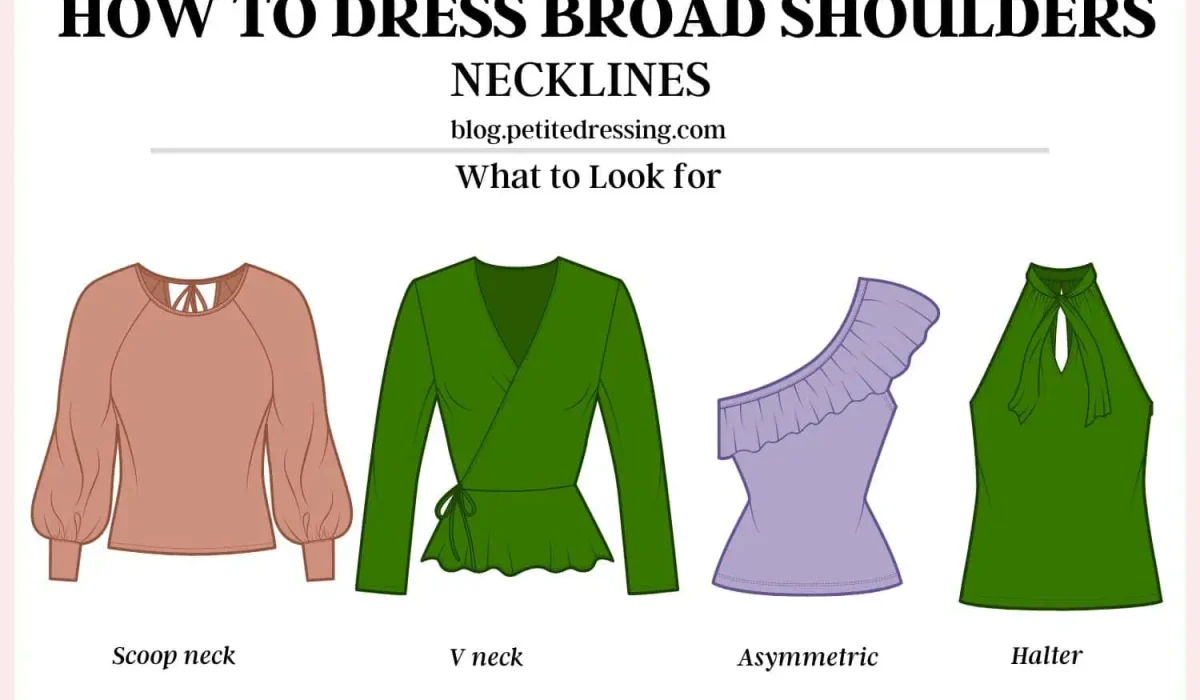
Shopping for tops can feel a little confusing when you have broad shoulders. You may find yourself wondering whether a certain neckline will make your shoulders look wider or whether a loose top will actually create the balance you’re looking for.
The truth is, there are no strict fashion rules you have to follow.
If you like your shoulders, you don’t need to hide them. If you’d rather create a softer or more balanced silhouette, however, choosing the right neckline, sleeve shape, fabric, and top length can help.
Learning how to choose tops for broad shoulders is really about understanding proportions and finding clothes that make you feel comfortable and confident.
Here’s a simple step-by-step guide to help you shop with less guesswork.
Step 1: Start With Your Shoulder Fit
Before thinking about necklines or colors, make sure the top actually fits your shoulders.
This is especially important if you have a broad upper body. A shirt that is too narrow across the shoulders can pull at the seams, restrict your arms, and make the whole outfit look uncomfortable.
When trying on a top, raise your arms, reach forward, and move your shoulders.
Look for enough room across your upper back and chest. The fabric shouldn’t feel stretched when you move.
A comfortable fit should always be your first priority.
Step 2: Decide What Look You Want
Ask yourself what you’re trying to achieve.
Do you want to:
- Make your outfit look more balanced?
- Create a longer-looking neckline?
- Draw attention toward your waist?
- Soften the appearance of your shoulders?
- Highlight your shoulders instead?
There isn’t one correct answer.
If you love your shoulders and want to emphasize them, structured or open-neck styles may be perfect.
If you’d prefer to visually soften the upper body, you’ll probably want to focus on vertical lines, softer fabrics, and less volume around the shoulder area.
Knowing your goal makes shopping much easier.
Step 3: Try V-Neck Tops
A V-neck is a simple place to start.
The downward shape creates a vertical line through the upper body and can draw attention toward the center of the torso.
You don’t need a very deep neckline. A modest V-neck can provide a similar effect while still offering plenty of coverage.
For casual outfits, try a simple V-neck T-shirt. For work or dressier occasions, a V-neck blouse can create a polished look.
Step 4: Consider Scoop Necklines
If you don’t love V-necks, try a scoop neckline.
A scoop neck opens up the area around the collarbone without creating a strong horizontal line across the shoulders.
It’s an easy option for T-shirts, sweaters, knit tops, and casual blouses.
Choose a deeper scoop if you want more openness or a higher scoop if you prefer additional coverage.
Step 5: Experiment With Wrap Tops
Wrap tops are useful because they naturally create diagonal lines across the torso.
Instead of drawing attention straight across the shoulders, the overlapping fabric guides the eye toward the waist.
Many wrap tops are also adjustable, which makes it easier to customize the fit.
Look for fabrics that drape naturally rather than extremely stiff materials. A soft wrap blouse can be especially flattering for both casual and dressy outfits.
Step 6: Choose Sleeve Shapes Carefully
Sleeves can completely change the way a top looks.
If you’re trying to minimize visual width around the shoulders, you may want to be careful with styles that add volume directly at the shoulder.
For example, large puff sleeves, strong shoulder pads, and exaggerated cap sleeves can make the shoulder area look more prominent.
Instead, consider:
- Raglan sleeves
- Relaxed long sleeves
- Straight sleeves
- Three-quarter sleeves
- Soft dolman sleeves
Again, these aren’t rules. If you love statement sleeves, wear them. The important thing is knowing what effect they create.
Step 7: Try Raglan Sleeves
Raglan sleeves have seams that run diagonally from the neckline toward the underarm.
This creates a softer transition between the neck and shoulder.
Raglan tops are particularly useful for casual clothing, sweatshirts, sweaters, and relaxed T-shirts.
They can also be more comfortable if standard shoulder seams feel restrictive.
Step 8: Look for Soft, Draping Fabrics
Fabric can influence the overall silhouette just as much as the cut.
Soft materials tend to fall naturally over the body instead of creating extra structure around the shoulders.
Depending on the garment, lightweight cotton, viscose, rayon, jersey, and soft knits can all work well.
However, don’t automatically choose oversized clothing.
A very loose, stiff top can add volume rather than soften the silhouette.
Aim for fabric that skims your body without clinging tightly.
Step 9: Think About Top Length
The length of your top can help balance your proportions.
A top that finishes around the waist can highlight your middle and work particularly well with high-rise trousers or jeans.
A longer top can create a relaxed look and work nicely with straight-leg or slim bottoms.
If your goal is to balance broad shoulders, consider adding some visual interest around the waist or hips rather than choosing a top that is simply oversized from top to bottom.
Step 10: Use Vertical Details
Vertical details can help create a longer visual line.
Look for tops with:
- Long button plackets
- Vertical seams
- Open cardigans
- Subtle vertical stripes
- Long necklaces
- V-shaped necklines
These details can guide the eye up and down instead of emphasizing the width of the shoulders.
You don’t need to combine several of them at once. Even one simple vertical detail can change the overall feel of an outfit.
Step 11: Choose Colors That Match Your Style
Color is another way to play with proportions.
If you want a more understated upper body, darker or neutral shades can be easy choices.
Black, navy, charcoal, olive, brown, and other muted colors can create a streamlined appearance.
But don’t feel like you have to avoid bright colors.
A colorful top can look fantastic with broad shoulders. If you want more balance, simply pair it with bottoms that have a little more visual interest or volume.
Step 12: Don’t Forget Button-Down Shirts
A classic button-down shirt can be surprisingly versatile.
The key is finding one that gives your shoulders enough room without looking excessively oversized.
A slightly relaxed shirt can be more comfortable than a tightly tailored one.
You can also leave the top button or two open to create a subtle V shape.
Try tucking the shirt into high-rise jeans or trousers to define your waist and create a more balanced silhouette.
Step 13: Consider Peplum and Waist-Defined Tops
If you want to create more balance between your shoulders and lower body, tops that add subtle shape around the waist or hips can help.
Peplum tops are one example. They fit closer around the waist and then flare slightly below it.
This creates visual interest lower on the torso.
You can also achieve a similar effect with a tucked-in blouse, belted shirt, or fitted top paired with wider-leg trousers or an A-line skirt.
Step 14: Be Careful With Shoulder Details
If you’re trying to minimize shoulder width, pay attention to decorative details placed directly in that area.
Large bows, heavy embellishments, epaulettes, shoulder pads, and strong horizontal seams can all draw attention toward the shoulders.
This doesn’t mean you can’t wear them.
Simply ask whether you’re trying to highlight your shoulders or create a softer appearance.
Fashion should help you express yourself rather than make you feel like you’re following restrictions.
Step 15: Balance the Rest of the Outfit
A top doesn’t work in isolation.
If you choose a simple, fitted top, you can create balance with wide-leg trousers, bootcut jeans, or an A-line skirt.
If you’re wearing a looser top, a more streamlined bottom can prevent the outfit from feeling too bulky overall.
The goal is to think about the entire silhouette rather than focusing only on your shoulders.
Step 16: Test the Top Before Buying
Always move around when trying on a top.
Raise your arms, stretch forward, sit down, and turn from side to side.
Check whether the shoulder seams stay comfortable and whether the fabric pulls across your upper back.
Also look at the neckline from different angles.
A top that looks great while you’re standing still may feel completely different once you start moving.
If you’re shopping online, check the measurements, fabric composition, customer reviews, and return policy before ordering.
Common Mistakes to Avoid
One common mistake is buying a top that’s too small across the shoulders simply because you prefer a fitted look.
A tight shoulder area can make the garment look strained and uncomfortable.
Another mistake is assuming that oversized clothing automatically balances broad shoulders. Too much fabric can sometimes make the entire upper body look larger.
It’s also easy to follow body-shape rules too strictly. Fashion is personal, and you should never feel that you’re “not allowed” to wear a certain neckline or sleeve.
Use styling advice as a tool—not a restriction.
Quick Shopping Checklist
Before buying a top, ask:
- Does it fit comfortably across my shoulders?
- Can I move my arms freely?
- Do I like the neckline?
- Does the sleeve shape create the look I want?
- Does the fabric drape nicely?
- Is the length flattering with my usual bottoms?
- Does the top work with clothes I already own?
- Am I comfortable and confident wearing it?
If the answer is mostly yes, you’ve likely found a good match.
Final Thoughts
Learning how to choose tops for broad shoulders doesn’t mean limiting yourself to a handful of styles. It’s about understanding how different design details affect the overall silhouette.
V-necks, scoop necks, wrap tops, raglan sleeves, soft fabrics, and waist-defined styles can all be useful options. At the same time, structured shoulders and dramatic sleeves can be great choices when you want to make your shoulders a feature.
Start with fit, then consider neckline, sleeves, fabric, length, and color.
Most importantly, wear what makes you feel good. Broad shoulders can look strong, elegant, sporty, or feminine depending on how you style them. The best top isn’t simply the one that follows a fashion rule—it’s the one that fits well and feels like you.


